

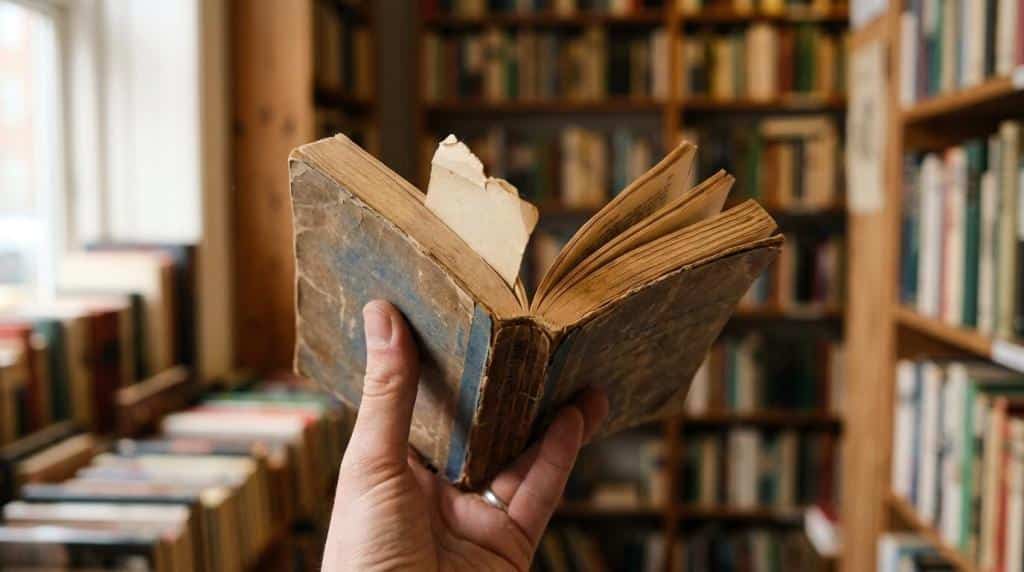
There is something special about taking a book off the shelf and feeling that it has already had a life. Maybe the spine is slightly soft, maybe there is an old bookmark between the pages, or maybe there is a name on the first page. That does not change the value of history. Often, it just makes the experience more human.
Buying used books has become a conscious choice for many readers. Not only because it’s cheaper, but also because it gives access to more titles, less resource consumption and a different kind of reading pleasure. When books are allowed to circulate further, reading becomes both more accessible and more responsible.
Financial gains from buying used books
The most obvious advantage is the price. Used books often cost significantly less than new ones, and the difference is not just small. Across European second-hand trade , the savings are typically 50 to 70 percent, and some finds can be even cheaper. This means that the same budget can be enough for an entire stack of books instead of a single new release.
It’s hard to find a more affordable medium than a good used book.
For students, families with children and avid readers, it makes a real difference. A novel, a biography, or a cookbook doesn’t have to be brand new to be useful. When the price drops, it also becomes easier to try out new genres. You dare to buy the collection of poems you are curious about, or the large art book you would otherwise have left alone.
| Situation | Approximate new price | Approximate Price Used | Possible savings |
|---|---|---|---|
| Typical second-hand find in Europe | 100 kr. | 30 to 50 kr. | 50 to 70% |
| Particularly strong find | 200 kr. | 7 to 20 kr. | 90% or more |
The price difference also does something else: it creates freedom. Instead of considering each purchase for a long time, one can build a personal library slowly and wisely. Second-hand books make reading more accessible without lowering the quality of the content.
After a while, the benefits become very tangible:
- Multiple books for the same amount
- Low risk when buying impulse
- Better opportunity to collect series
- Room for both entertainment and non-fiction
Sustainability and climate of used books
A new book seems like a single product, but behind it lies paper production, printing, transport and packaging. Calculations of the book’s life cycle point to a climate footprint of around 3.6 to 7.5 kg CO2e for a newly printed copy. When you choose used, you skip the entire production stage for that particular specimen.
This makes used books a strong choice in a more circular everyday life.
When the same book is read by several people over time, its total resource consumption is distributed over several readings. It is a simple but effective mechanism. The paper has already been produced, the transport has already taken place, and the value of the book can continue for many years without new loading.
There is also an important symbolic value in it. A book is not a disposable item. It is created to be read more than once, by more than one person. Buying it used is therefore not an emergency solution, but a way to use the product that it actually invites.
In Denmark, recycling in a broad sense already helps to save significant amounts of CO2 every year. When it comes to books, the benefit is particularly obvious because they often last a long time and still have full function, even when they no longer look new.
Cultural value in used books and old publications
Used books provide access to something that the new book market cannot always provide: back catalogues, discontinued titles and books that are no longer available in the bookstore. This applies to classics, non-fiction books, older translations, special editions and small editions that would otherwise be difficult to find.
Many readers also discover that the second-hand market can be more inspiring than a pure flow of news. Instead of only meeting what is being published now, you get in touch with books that have held value over time. It creates a different kind of reading culture where quality is not tied to the publication date.
There is also something social in it. A used book has often moved through several homes, shelves and hands. It has been passed on, exchanged, sold or returned. That circulation keeps stories and knowledge alive, and it makes it easier to share reading experiences across economies and generations.
It is not only the books that live on. So do the conversations about them.
What to look for when buying used books
Although there are many pluses, buying used books requires little attention. The condition varies, and not all buyers have the same tolerance for wear. Some love patina. Others prefer sharp edges and clean sides. Both are fair, as long as you know what you’re going for.
The most important thing is to evaluate the book as a reading object, not as a perfect commodity. A slightly bent back rarely matters. A strong smell of moisture or missing sides, on the other hand, makes a real difference. When buying online, images and descriptions are essential. When buying in store, the advantage is that you can stand with the book in your hand and flip through it.
A short checklist makes it easier to sort quickly:
- Check the edition: ISBN, translation and year can be crucial, especially for non-fiction books and classics.
- Assess the condition: Look for loose sides, underlines, moisture traces and wear on the back.
- Mark the paper: Yellowing is normal, but very brittle paper can be a sign of weak durability.
- Think about the purpose: A study book often requires more precision than a holiday novel.
- Compare the price: A used book should make sense in relation to the new price and condition.
Accessibility can also be a challenge. If you’re looking for a specific title, it may require patience. But for many, that search is part of the charm. Second-hand book buying is not just a transaction. So is the hunt.
Physical second-hand shops make second-hand books more present
Online shopping is convenient, but brick-and-mortar stores have some clear strengths when it comes to books. You can turn the pages, label the type of paper, see the cover in real life and quickly determine if the condition and edition suit your needs. At the same time, spontaneous finds occur more often because the books are related to each other on a shelf and not just as search results.
This is especially true in stores with a wide second-hand range, where books are a natural part of a larger recycling culture. In Nørrebro, Genbro is a good example of this model. The store is physical, large and locally rooted, and in the category of books and media you can find everything from novels and non-fiction books to children’s books, magazines and comics. The range changes continuously because new products come in every day.
It makes the experience more alive than a static warehouse. You can come in for a certain type of book and walk out with a title you had no idea you were looking for. For many readers, this is exactly what makes secondhand interesting.
Genbro also works with fixed low prices and a curated selection. That is an important detail. When the selection is sorted and does not seem random, it becomes easier to orient oneself, and the books become part of an inspiring shopping trip rather than a messy compromise. According to the store’s own description, items are reviewed before they hit the shelves, and this contributes to a safer shopping experience.
For readers in Copenhagen , this type of store means something special. It connects finance, sustainability and everyday practice. You can find a book, a piece of furniture and a lamp in the same place, and the entire purchase is within the same second-hand logic.
Why used books are suitable for everyday life in Copenhagen
In a city like Copenhagen, it makes extra good sense to buy used books. Housing is often smaller, budgets can be tight, and many people want to act more responsibly without making everyday life difficult. Used books fit directly into that reality. They are cheap, easy to take home and easy to pass on.
This applies both to the student who lacks reading material without using the entire SU, and to the family who wants to fill the children’s room with books without paying a new price every time. The second-hand market also makes sense for the experienced reader, because it opens up for titles that are rarely in regular trade.
There are several good reasons why second-hand books work so well in the city:
- Local accessibility: Physical thrift stores make it possible to shop spontaneously on your way through the city.
- Low cost: It’s easier to build a home library a little at a time.
- Variety: The selection changes quickly, so there is often something new to look for.
- Divisibility: Used books are easy to exchange, lend or give away.
- Less waste: More readers can benefit from the same copy.
This model supports a reading culture where books are not just bought and saved, but actively circulated.
How to get more out of buying used books
A good habit is to start second-hand before buying new. If you have a wish list, let it live for a few weeks and look for the titles in thrift stores, marketplaces or in local book corners. Many books appear when you least expect it, and patience is often rewarded with both a better price and more satisfying finds.
It also pays to think in categories instead of exact titles. If you know that you want to read modern Danish literature, architecture, food, philosophy or children’s books, it opens up far more opportunities. The second-hand market rewards the curious reader.
Some of the best purchases occur precisely where the plan gets a little loose. A book with a good subject, a nice binding or a strong first page can be enough to take a chance. And when the price is low, that chance is far easier to take.
This is perhaps the most underestimated strength of buying used books: reading does not become less valuable just because the book has already been on another shelf. Often it becomes more interesting.


