

There is something special about a plate from Royal Copenhagen that has hung on a wall, stood in a display cabinet or been unpacked every December for many years. Used collectible plates and Christmas plates, often referred to as cheese, are not just decorative items; They may also be adorned with motifs such as fish, adding further depth to their aesthetic and cultural value. They contain traces of taste, tradition, craftsmanship and Danish home culture, which is why they continue to be interesting for both collectors and ordinary buyers.
For many, the interest begins with a single find, perhaps a plate from Royal Copenhagen. A blue-and-white Christmas plate with a winter motif. A wall plate from a well-known porcelain house. An older plate where the glaze, stamp and motif point back to a time when this kind of thing was bought with the intention of being saved. When you buy second-hand, you get access to that story in a more down-to-earth way, and often at prices that make it possible to buy with both curiosity and consideration.
Why collectible plates still fascinate today
Collectibles such as collectible plates have gained a new place in many homes, where they are often used as unique tapas serving dishes. Not as dusty relics, but as objects or dishes that can add character to a wall, an open cupboard or a quiet nook in the home. They fit well into a time when many want things with patina, history and duration, perhaps even served with good bread.
This is especially true for Christmas plates. They are linked to repetition and tradition, and this type of object often becomes more important over time. A plate may have been bought for the sake of the motif, but it may end up being saved, passed on and rediscovered in a new context.
Many people are attracted to collectible plates for several reasons, and often they seek more information about collectibles such as Christmas plates on a relevant website:
- Danish porcelain history
- Winter motifs and classic Christmas themes
- Decorative value in the home
- Joy of collecting
- the feeling of finding something unique
There is also a liberating simplicity in the format. A plate does not require much space, but can still have high aesthetic and historical value. This makes it obvious for both new collectors, students, design enthusiasts and anyone who wants to shop more second-hand without compromising on expression, especially when it comes to collectibles and collectibles.
The story behind Christmas plates and Danish porcelain plates
When collectible plates arouse interest, it is often because they are part of a larger tradition. In Denmark, Christmas plates are closely associated with porcelain factories such as Bing & Grondahl and Royal Copenhagen, and these names still take up a lot of space in the market for used plates. The early vintages are particularly in demand because they mark the beginning of a series or a strong design tradition.
However, history does not mean that everything old is automatically valuable. Many later Christmas platters were produced in large quantities, and therefore the demand depends on several things at once. The manufacturer counts. The year group counts. The motive counts. And the stand almost always counts more than many people think.
A good rule of thumb is to look at the interplay between four factors: age, manufacturer, condition, and visual appeal. When they come together, you get a plate that can be both beautiful to look at and interesting to collect.
What gives a used plate value
Value is a broad word. For some, it’s about market price, while for others, it may be related to something as simple as cookies baked during the Christmas season. For others, it’s about cultural history, design or the right atmosphere in the home. On the second-hand market, these things are often connected, but not always.
An older plate from a well-known manufacturer such as Royal Copenhagen can be relatively common, while a less obvious plate can be rare and difficult to find. Therefore, it is smart to look a little more systematically at what you are facing.
| Factor | What to look for | Significance |
|---|---|---|
| Producer | Royal Copenhagen, Bing & Grondahl and other well-known porcelain houses | Creates trust and interest |
| Vintage | Early releases or special anniversary years | Can increase collector’s value |
| Condition | No cracks, grudges, or obvious restoration | Of great importance |
| Motive | Classic winter motifs, churches, landscapes, nature | Increases decorative appeal |
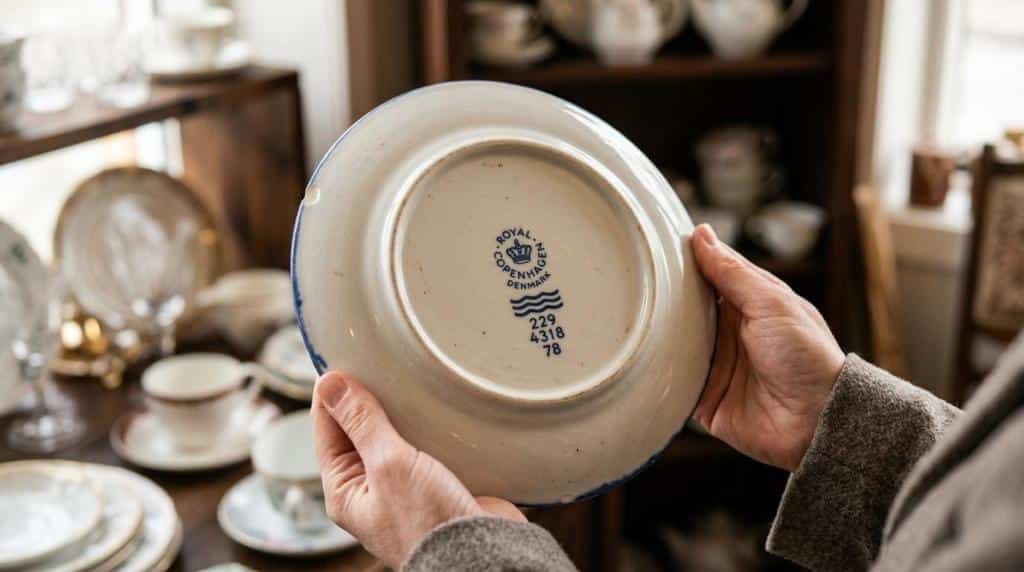
| Backstamp | Original brand, number, year and sorting | Helps with identification |
| Completeness | Series, Key Year or Original Box | Make plates more attractive |
This is exactly where used finds become exciting. You may be lucky enough to find a Christmas plate that at first seems modest, but which turns out to have an interesting stamp or an early dating on the back. Such findings rarely occur in mass-produced retail environments. They occur when the range changes and when you look closely.
How to assess the condition and authenticity of assembly plates
If a plate, such as from Royal Copenhagen, is to function as more than just decoration or serving, it is important to control it well. This applies to both Christmas plates, wall plates and other porcelain plates of collector’s interest, as they often serve as collector’s items.
Start by turning it over. The back is often far more informative than the front page. Here you can find stamps, years, model numbers and markings that help you assess whether you have an original piece of porcelain from the period you think.
When reviewing a Christmas plate or other plate, these points are particularly helpful:
- Stamp: Check the manufacturer label and whether it matches style, color and age
- Year: See if the vintage and motif fit logically together
- Sorting: The first sorting is often more sought after than the second sorting
- Edge: Feel for small grudges, rejections and bumps
- Surface: Look for cracks, scratches or signs of repair
- Suspension: Check if rear-mounted suspension works later added
Even small injuries can significantly affect interest. A nice plate with an almost invisible edge rejection is not necessarily without value, but it will often be in a different price range than a copy in very good condition. It is an advantage for the buyer if the goal is to decorate with historical finds without paying collector’s prices.
Used Christmas plates as both collector’s items and home finds
Christmas plates, especially from Royal Copenhagen, are in a special category because they can be both nostalgic and stylish. Many of the classic blue and white plates work surprisingly well in modern homes, especially when hung individually or combined with wood, glass, vegetables and textiles in calm colours.
This also makes Christmas plates from Royal Copenhagen an obvious place to start if you want to buy used porcelain with history. The motifs are often easy to like, and the market range is large enough to start without being an expert. At the same time, there are plenty of nuances for the more experienced collector who is looking for specific vintages or producers.
In practice, you can collect in several ways:
- One specific brand
- Only early vintages
- Specific motives
- Plates with local or personal meaning
- A mix of decorative favourites
It gives freedom. A joint doesn’t have to be complete to be strong. It can also be curated according to gaze, mood and the stories you want to give space.
Where to find used collectibles in Copenhagen
When looking for collectible plates, physical second-hand shops are often more interesting than classic webshop environments. This is especially true if you want to see the condition, hue, relief and reverse stamp with your own eyes. Many plates, including Royal Copenhagen, look similar in pictures, but feel very different in the hand.
In Nørrebro , it is obvious to keep an eye out for second-hand shops, where the selection changes often and where home items, porcelain and collectibles stand side by side. A place like Genbro is relevant precisely because the store works with a wide second-hand range and receives new items every day. Here, plates can appear as part of home finds, design objects and classic everyday objects, and this makes the hunt more alive.
It’s rarely the most detailed filters on a screen that lead to the best finds. Often it is the combination of timing, knowledge and physical gaze. If you’re looking for plates with history, it makes sense to go for sections and shelves where porcelain, handicrafts, design and collectibles are gathered.
A good strategy is simple:
- Frequently visits: The selection changes quickly, and unique items are rarely found in multiple copies
- Ask: The staff can often point you in the direction of newly delivered porcelain
- Compare calmly: Look at several plates side by side before choosing
- Think broadly: Some of the best finds are not necessarily among Christmas items
Which plates are typically most in demand
The market repeatedly points to some common characteristics. Early Christmas plates from well-known manufacturers such as Royal Copenhagen are of high interest. Well-preserved plates with a clear stamp do well. Erotic or very niche motifs take up less space in the broad demand, while classic winter landscapes, churches and nature scenes continue to have appeal.
This does not mean that you should only buy the most well-known names. On the contrary, a more open approach can lead to strong findings. Some buyers go for the role of the plate in the home more than its collector’s location. If the motif, colour and shape are right, a less famous plate may be a better buy than a more expensive and well-known vintage.
Especially autumn and the time leading up to Christmas make Christmas plates extra visible. Many people think of them as seasonal decorations, gift ideas, or a way to bring tradition into the home. If you buy outside the high season, you can often choose more calmly and with a better overview.
How to build a personal collection of tiles
The strongest collection is rarely the most complete. It is the most conscious. If you want to build a collection that is both beautiful and meaningful, you may want to start with a clear direction. Not as a rule, but as a compass.
Maybe you only want to collect blue and white Christmas plates. Maybe you only want plates from Danish porcelain manufacturers such as Royal Copenhagen. Maybe you want to use them in the home instead of storing them away. This is a great advantage because it makes it easier to sort between many options when you are standing in front of a shelf full of porcelain.
There is also something uplifting in letting the collection grow slowly. Second-hand finds win by patience. A collection that has been found over time often takes on more character than one that has been bought ready-made at once. Each plate becomes an impact in a quest, a taste and a decision.
This makes Christmas plate collectibles more than a nostalgic niche field; They become prized collector’s items. They become a concrete way of choosing quality, history and recycling in the same movement. And that is precisely why they continue to make sense in cities like Copenhagen, where the desire for personal homes and more responsible purchases go hand in hand. When the right plates appear, they are not just leftovers from the past. They become active parts of a home that values things with lived life.